LinkedIn Post
The rollout starts after setup
AI rollout often looks clean on day one, but the real work starts after people use the system. This post argues that AI adoption needs ownership and operating loops to stay useful.
Key takeaways
- AI rollout looks clean on day one, but the messy part starts after real use.
- Source hygiene, skill improvement, output review, team sharing, and lightweight governance keep the system usable.
- AI adoption becomes real when the team knows how to maintain and improve the system together.
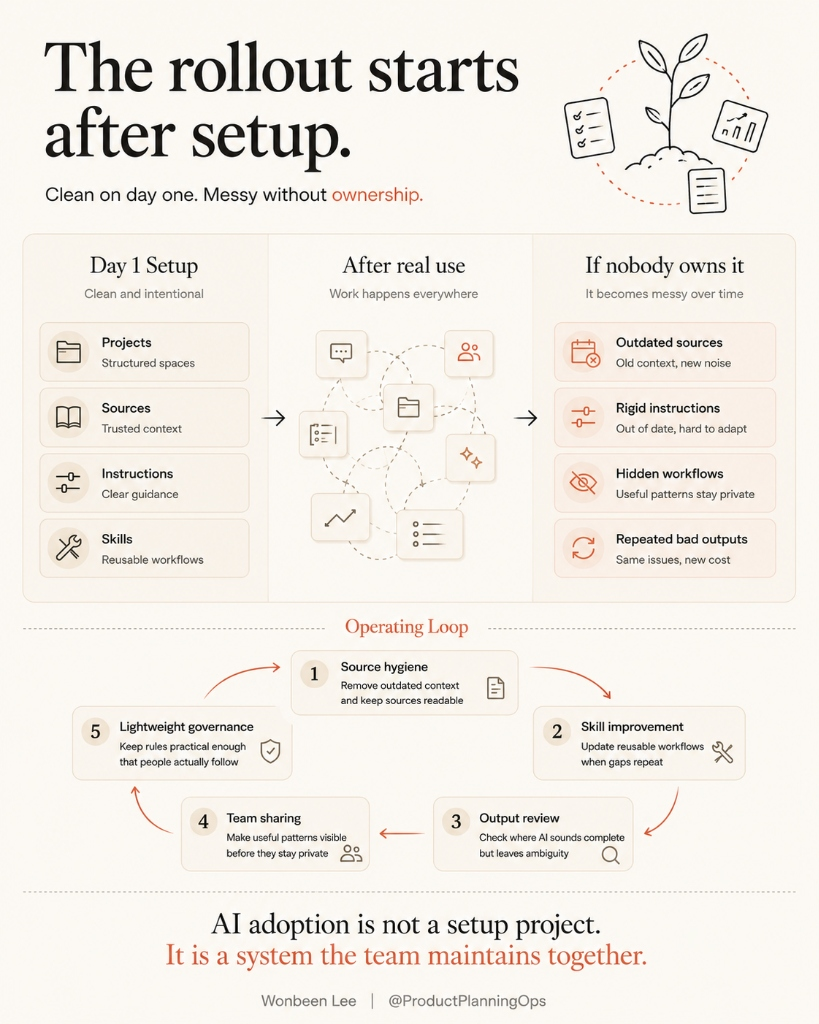
Most AI rollouts look clean on day one.
The messy part starts later.
𝗪𝗵𝗲𝗻 𝗻𝗼𝗯𝗼𝗱𝘆 𝗸𝗻𝗼𝘄𝘀 𝘄𝗵𝗼 𝗼𝘄𝗻𝘀 𝘁𝗵𝗲 𝘀𝘆𝘀𝘁𝗲𝗺.
That was one of the biggest lessons I learned while introducing 𝐂𝐥𝐚𝐮𝐝𝐞 to our product planning team.
At first, the work looked like setup.
□ Project spaces.
▥ Sources.
▤ Instructions.
▩ Connectors.
▦ Skills.
Those things mattered.
But after people started using Claude in real planning work, a different set of questions appeared.
• Which sources are actually useful?
• Which instructions are too rigid?
• Which skills are used repeatedly?
• Which outputs are good enough to reuse?
• Which patterns should be shared with the team?
• Which old context should be removed before it becomes noise?
That was when I realized:
𝐀𝐈 𝐚𝐝𝐨𝐩𝐭𝐢𝐨𝐧 𝐝𝐨𝐞𝐬 𝐧𝐨𝐭 𝐬𝐭𝐚𝐲 𝐜𝐥𝐞𝐚𝐧 𝐛𝐲 𝐢𝐭𝐬𝐞𝐥𝐟.
A project space can become cluttered.
A source can become outdated.
A skill can become too specific.
A useful workflow can stay invisible if no one shares it.
A bad output can keep repeating if no one turns it into a learning point.
So the real work was not just launching Claude.
It was 𝐤𝐞𝐞𝐩𝐢𝐧𝐠 the system usable.
For me, that meant creating a few simple operating loops:
① Source hygiene
→ remove outdated context and keep shared sources readable
② Skill improvement
→ update reusable workflows when repeated gaps appear
③ Output review
→ notice where AI sounds complete but still leaves ambiguity
④ Team sharing
→ make useful patterns visible before they stay private
⑤ Lightweight governance
→ keep rules practical enough that people actually use them
This was not the most exciting part of AI adoption.
But it may have been the part that mattered most.
Because without maintenance, AI slowly becomes another messy workspace.
More files.
More prompts.
More instructions.
More unclear outputs.
But with shared ownership, it can become something different:
a system the team keeps improving together.
That is the final lesson I took from this rollout.
AI adoption is not finished when the tool is available.
✦ It starts becoming real when the team knows how to maintain, improve, and learn from the system together.
𝑸𝒖𝒆𝒔𝒕𝒊𝒐𝒏:
| After your team introduces AI, who owns keeping the system useful?
#ProductManagement #ProductOps #AIinProduct #AIFluency #WorkflowDesign